Thoracic Extension
A gentle upper-back mobility drill that restores your mid-back's natural ability to arch — undoing the rounded, stiff posture that years of sitting and screen time quietly lock in.
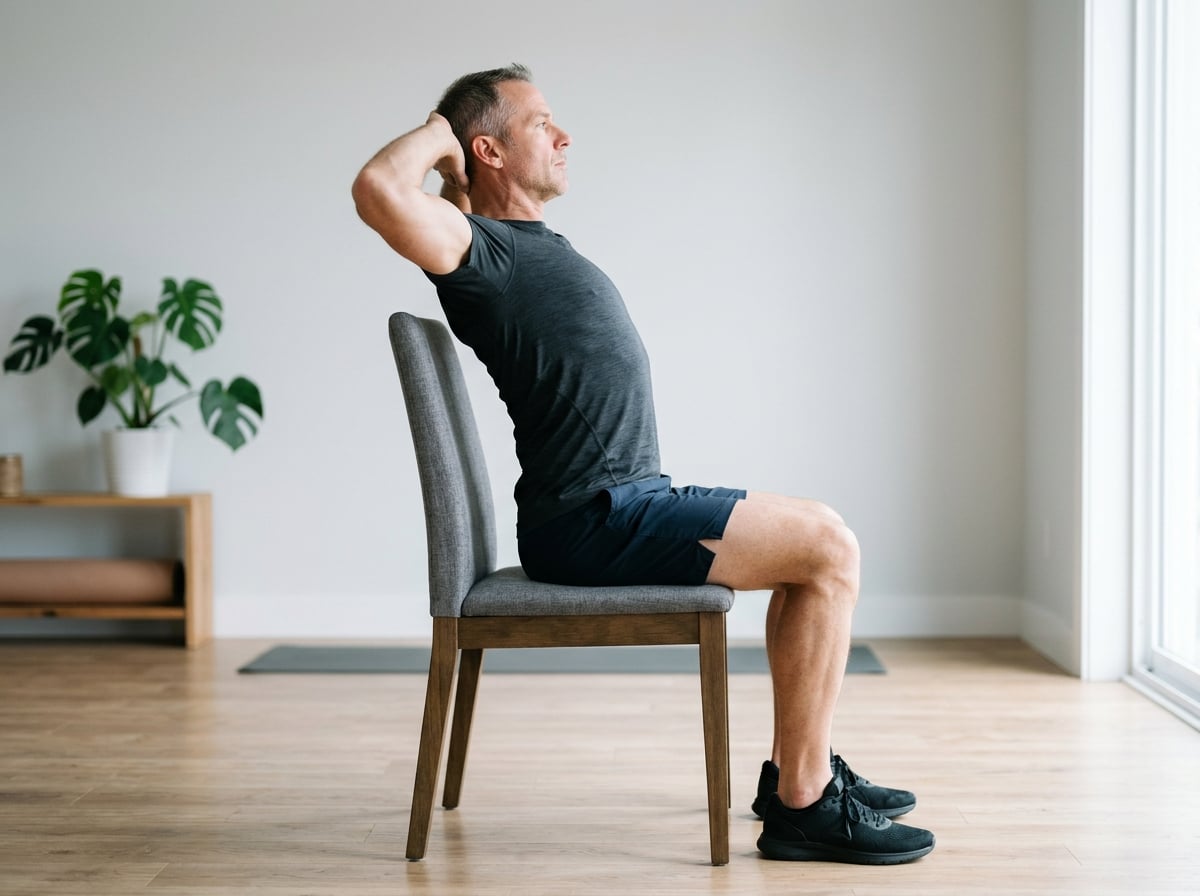
How to Do It
- 1Sit tall in a sturdy chair with a firm back edge at about mid-back height
- 2Interlace your hands behind your head to support your neck, elbows pointing forward
- 3Brace your core gently to lock your lower back in place
- 4Slowly arch your UPPER back backward over the top edge of the chair
- 5Move only the mid-back — do not let the movement come from your lower back
- 6Extend until you feel a gentle stretch across the upper back, then pause 2–3 seconds
- 7Return smoothly to upright and repeat for about 10 reps
- 8Perform 2 sets; a foam roller under the upper back works the same way if you have one
Back Pain After 40
This move is one piece of a bigger picture. See how it fits into the free 5-minute routine — plus the other no-equipment exercises chosen specifically for the muscles that fail after 40.
Explore the Back Pain After 40 guideCommon Mistakes to Avoid
Make It Easier
- Smaller range of motion
- Use a lower chair edge or towel roll for support
- Perform seated without the chair back, just gently arching
Make It Harder
- Foam roller extensions moving to 2–3 spots along the mid-back
- Add a light overhead reach at end range
- Hold end range for 5–10 seconds
Why Your Mid-Back Loses Its Ability to Extend
Your thoracic spine — the mid-back region behind your ribcage — is built to arch backward and rotate. But sitting hunched over a desk or phone parks it in the opposite position, flexed forward, for hours a day. Over time the joints and muscles adapt to that rounded shape and the mid-back simply stops extending well. That stiffness doesn't stay contained: when the thoracic spine can't move, the neck above it and the lower back below it are forced to compensate, which is a common hidden driver of both neck strain and lower-back ache. Thoracic extension directly restores the motion sitting steals — arching gently back over a chair edge or foam roller re-opens the mid-back, and with it comes better shoulder mechanics, easier overhead reach, and fuller, deeper breathing.
Thoracic Extension After 40 — Restore the Motion Sitting Steals
The longer you've been sitting for a living, the stiffer the mid-back tends to be — so after 40 this is one of the most valuable mobility drills you can keep in your routine. Because it's light and low-risk, you can do it daily: about 10 reps for 2 sets over a firm chair back, pausing 2–3 seconds at a comfortable end range, or 10–12 slow reps on a foam roller, moving it to 2–3 spots along the mid-back. The single most important cue is to isolate the movement to the thoracic spine — brace your core gently so the arch doesn't sag into your lower back, and let your hands support your neck without cranking on it. Consistency wins here: five to ten minutes of mobility most days does far more than an occasional long session. Pair it with cat-cow and the reverse snow angel for a complete upper-back and posture reset.
Frequently Asked Questions
What does the thoracic extension exercise do?
It restores your mid-back's (thoracic spine's) natural ability to arch backward — a motion that hours of sitting and slouching slowly take away. Improving thoracic extension counters a rounded upper back, improves shoulder mechanics and overhead reach, makes fuller breathing easier, and takes compensatory strain off the neck and lower back above and below it.
How many reps of thoracic extension should I do?
For chair-based extensions, about 10 reps for 2 sets works well, pausing 2–3 seconds at the gentle end range. On a foam roller, 10–12 slow reps is a common recommendation, and you can move the roller to 2–3 spots along the mid-back. It's a light mobility drill, so daily practice is fine and encouraged — 5–10 minutes of mobility most days beats occasional hard sessions.
Is thoracic extension good for upper back pain?
Yes — for the stiff, achy upper back that comes from prolonged sitting, restoring thoracic extension is one of the most useful things you can do. The critical form point is to move from the mid-back, not the lower back: brace your core gently so the motion stays where you want it. If your pain is sharp, radiating, or from a specific injury, check with a professional first.
Chair or foam roller — which is better for thoracic extension?
Both work well; the best one is the one you'll actually do. The chair version is the most accessible — you can do it anywhere you have a firm-backed seat, including at work. The foam roller lets you target several segments of the mid-back and often gives a slightly deeper stretch. Many people use the chair version during the day and the foam roller at home.
Why do I feel thoracic extension in my lower back instead of my upper back?
That means the movement is coming from your lumbar spine rather than your mid-back. The fix is to brace your core to 'lock' the lower back, keep the range smaller, and consciously arch only over the top edge of the chair (or the roller) so the motion isolates the thoracic region. If you still feel it low, reduce the range until you can keep the movement in the upper back.
Quick Stats
Perfect For
Related Exercises
Helpful Fitness Tools
Plan your training and nutrition for better results:
55+ Free Exercises — No Equipment
Browse the full exercise library with step-by-step guides for every muscle group. All bodyweight, all free, all designed for home workouts.
Get The Weekly Formula — Free
Want more moves like this every week? Get one exercise, one insight, and one quick win — built for adults over 40. Free forever.
Send Me The Formula →