Knee Push-Up
A modified push-up performed from the knees that builds real chest, shoulder, and tricep strength — the most effective stepping stone toward full push-ups for beginners.
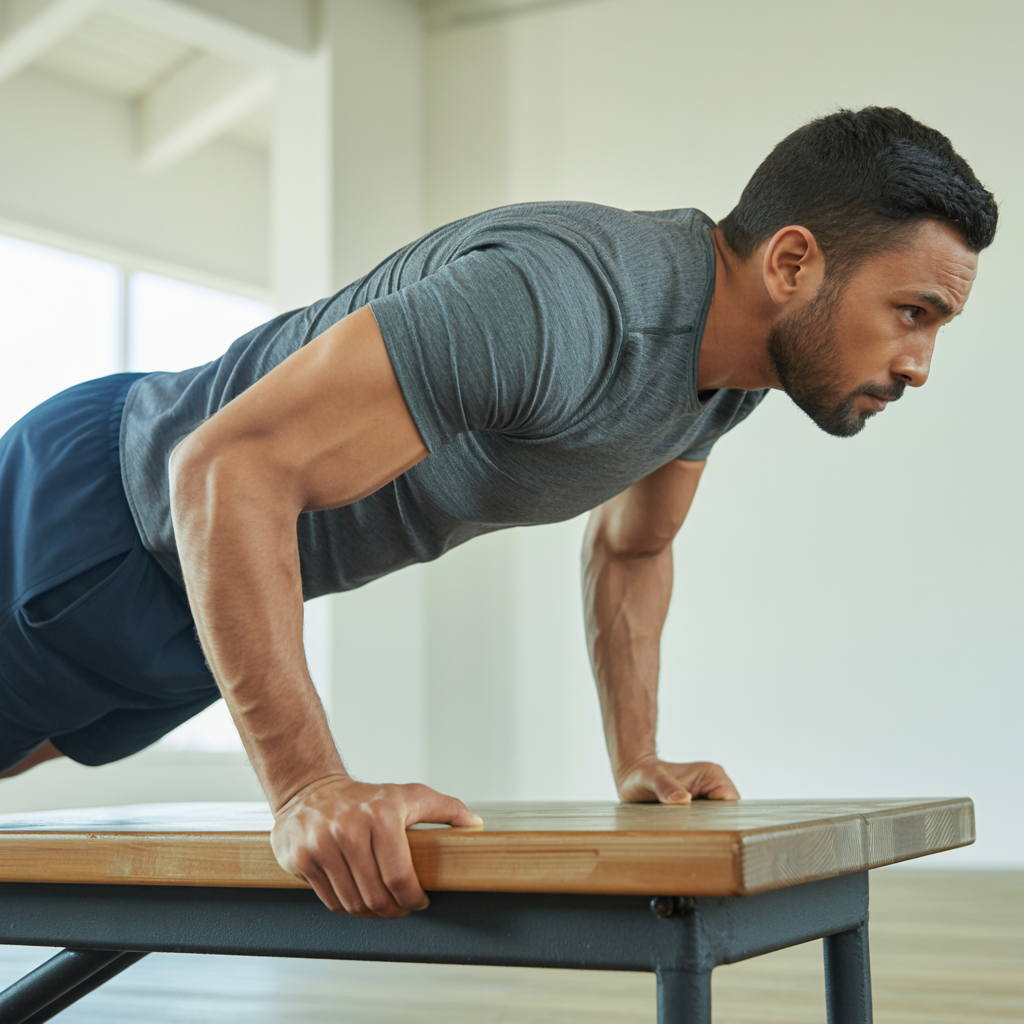
How to Do It
- 1Start on hands and knees
- 2Walk hands forward so body forms straight line from knees to head
- 3Cross ankles behind you (optional)
- 4Hands slightly wider than shoulders
- 5Lower chest toward floor
- 6Keep core engaged - don't let hips sag
- 7Push back up to start
- 8Focus on maintaining straight line from knees to shoulders
How Many Calories Do Knee Push-Ups Burn?
Push-ups — even the knee variation — burn more calories than people expect when performed in circuits with minimal rest. Your exact burn depends on weight, tempo, and volume. Use our free calculator to find your number.
Calculate Your Calories Burned →Common Mistakes to Avoid
Make It Easier
- Incline knee push-up
- Wall push-up
- Reduced range
Make It Harder
- Standard push-up
- Slow tempo
- Pause at bottom
Why Knee Push-Ups Deserve More Respect
Knee push-ups have an undeserved reputation as a "lesser" exercise — something you only do because you can't do "real" push-ups. That framing is wrong and counterproductive. The knee push-up is a legitimate upper body strength exercise that loads the chest, shoulders, and triceps at a reduced but meaningful percentage of body weight. For someone who cannot yet perform standard push-ups with proper form, knee push-ups are the most direct path to building the strength required to get there. They allow you to train the exact same movement pattern — horizontal pressing — through a full range of motion while maintaining form that would break down in a standard push-up. The alternative — doing standard push-ups with terrible form, sagging hips, and half range of motion — is both less effective and more likely to cause injury. Perfect knee push-ups build more real strength than sloppy full push-ups, every time.
Knee Push-Ups After 40 — Building a Pushing Foundation
Upper body pushing strength declines naturally with age, particularly if you haven't been training it consistently. After 40, wrist sensitivity, shoulder stiffness, and reduced core strength can make standard push-ups uncomfortable or impossible to perform with good form — and forcing them leads to compensations that cause injury. Knee push-ups solve this by reducing the load to approximately 50-60% of body weight while maintaining the full pressing movement. This lower load also means less wrist compression, which matters as wrist mobility decreases. If wrists are still bothersome, use push-up handles or place hands on dumbbells to maintain a neutral wrist position. The progression from knee push-ups to standard push-ups is straightforward: once you can do 3 sets of 15-20 with controlled tempo and full range, start mixing in a few standard push-ups at the beginning of each set while finishing with knee push-ups. Most adults can progress to full push-ups within 4-8 weeks using this approach.
Frequently Asked Questions
Are Knee Push-Ups effective for building strength?
Yes — knee push-ups are a legitimate strength exercise, not just a 'beginner cheat.' Research shows they still load the chest, triceps, and shoulders significantly, just at a reduced percentage of body weight compared to full push-ups. They're ideal for building the baseline pushing strength needed to progress to standard push-ups.
How many Knee Push-Ups should I do before progressing?
A common benchmark is 3 sets of 15–20 knee push-ups with controlled tempo and full range of motion before attempting standard push-ups. If you can hit 20 with clean form — chest near the floor, no hip sag, controlled descent — you have the strength foundation for full push-ups. Progress by doing a few standard push-ups mixed into your knee push-up sets.
What muscles do Knee Push-Ups work?
Knee push-ups work the pectoralis major (chest), anterior deltoids (front shoulders), and triceps as primary movers. The core is engaged as a stabilizer, though to a lesser degree than in standard push-ups because the shorter lever reduces the anti-extension demand. The serratus anterior is also activated during the pressing motion.
Are Knee Push-Ups bad for your knees?
They can cause discomfort if your knees are pressing directly on a hard surface. Use a folded towel, yoga mat, or cushion under your knees. The exercise itself doesn't stress the knee joint — the pressure is simply from body weight on the kneecap against the floor. If padding doesn't resolve discomfort, try incline push-ups (hands on a bench) instead.
What's the difference between Knee Push-Ups and Incline Push-Ups?
Both reduce the load compared to standard push-ups, but incline push-ups (hands elevated on a bench or wall) more closely replicate the muscle activation pattern of a full push-up because your body stays in a straight plank line. Knee push-ups change the lever length. Many trainers now recommend incline push-ups as the preferred regression, but knee push-ups remain effective and accessible.
Quick Stats
Perfect For
Related Exercises
Helpful Fitness Tools
Plan your training and nutrition for better results:
55+ Free Exercises — No Equipment
Browse the full exercise library with step-by-step guides for every muscle group. All bodyweight, all free, all designed for home workouts.
Get The Weekly Formula — Free
Want more moves like this every week? Get one exercise, one insight, and one quick win — built for adults over 40. Free forever.
Send Me The Formula →