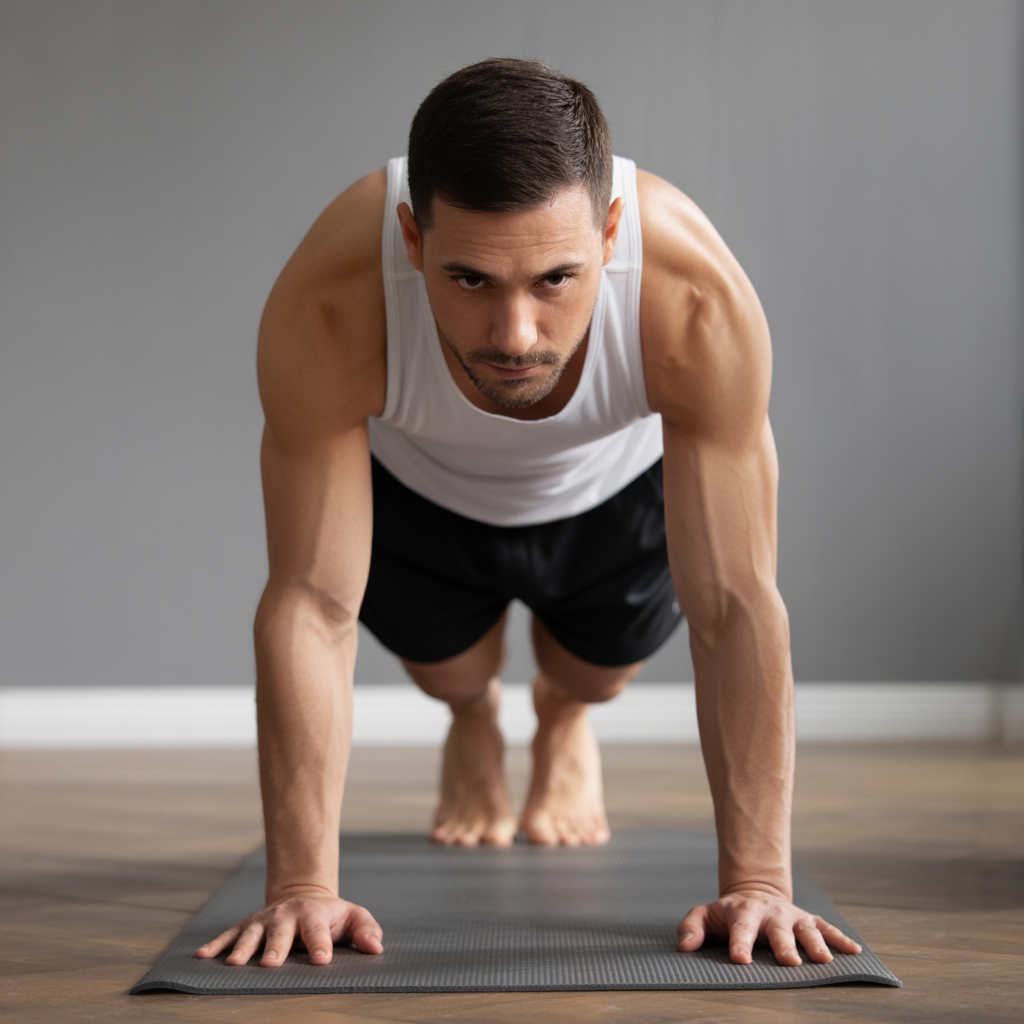
Plank Hold
The foundational core exercise that builds total-body stability and endurance. Essential for a strong, functional core.
Important: You Can't "Spot Reduce" Fat
This exercise strengthens Core (Rectus Abdominis, Transverse Abdominis), but fat loss happens holistically across your entire body through consistent training and nutrition. You cannot target fat loss in specific areas. The key is full-body balanced training combined with a sustainable calorie deficit. This is how your body naturally reduces fat over time.
How to Do It
- 1Start on forearms and toes
- 2Elbows directly under shoulders
- 3Body forms straight line from head to heels
- 4Engage core by pulling belly button toward spine
- 5Squeeze glutes and quads
- 6Keep neck neutral - look at floor
- 7Breathe normally throughout
- 8Hold for 20-60 seconds to start
Common Mistakes to Avoid
Make It Easier
- Knee plank
- Incline plank (hands on couch)
- Shorter hold time
Make It Harder
- Extended time (60-90+ seconds)
- Single-leg plank
- Plank with shoulder tap
Why This Exercise Matters
You need exercises that deliver results without requiring gym memberships, expensive equipment, or hours of your day. The plank hold is perfect because:
- No equipment needed - do it at home, anytime, anywhere
- Time-efficient - takes just 1 minute per set
- Builds real strength - targets core (rectus abdominis, transverse abdominis) for functional fitness
- Quiet enough - won't wake sleeping kids or bother neighbors
- Kid-friendly - can be done while children play nearby
- Small space - requires minimal room
Remember: consistent, sustainable training is better than sporadic intense sessions. Focus on form, build gradually, and trust the process.
Frequently Asked Questions
How long should I hold a Plank?
Quality matters more than duration. A 20-30 second plank with perfect form beats a 2-minute plank with sagging hips. Start with 3 sets of 20-30 seconds, progress to 45-60 seconds. Beyond 60 seconds, try harder variations instead of longer holds.
What muscles does the Plank work?
Planks work your entire core: rectus abdominis (front), transverse abdominis (deep core), obliques (sides), and erector spinae (back). They also engage shoulders, chest, and quads. It's one of the most complete core exercises available.
Are Planks better than Crunches?
For functional core strength, yes. Planks train core stability (resisting movement) which transfers to real-life activities and protects your spine. Crunches train flexion. Most people benefit more from stability training than repeated spinal flexion.
Why do Planks hurt my lower back?
Your hips are likely sagging, putting stress on your lower back. Fixes: squeeze your glutes, tuck your pelvis slightly, imagine pulling your belly button to spine, and don't hold longer than you can maintain form. Shorten the hold and focus on proper alignment.
Should I do Planks every day?
Yes, planks are safe for daily practice since they don't cause significant muscle damage. However, variety helps—rotate between front planks, side planks, and other core exercises. 2-3 dedicated core sessions per week is sufficient for most goals.
Quick Stats
Perfect For
Helpful Fitness Tools
Plan your training and nutrition for better results:
55+ Free Exercises — No Equipment
Browse the full exercise library with step-by-step guides for every muscle group. All bodyweight, all free, all designed for home workouts.
Get The Weekly Formula — Free
Want more moves like this every week? Get one exercise, one insight, and one quick win — built for adults over 40. Free forever.
Send Me The Formula →