
Why Your Back Hurts After 40 (And the Two Exercises That Actually Fix It)
Why Your Back Hurts After 40 (And the Two Exercises That Actually Fix It)
You bent over to tie your shoe, or picked up a laundry basket, or just stood up from your desk the wrong way. And now your lower back is screaming.
If you're over 40 and your back has started talking to you in ways it never used to, you are in extremely normal company. But here's the part almost nobody tells you: the problem is usually not that your spine wore out. It's that your back got weak. And weak is fixable.
Quick Answer
Most back pain after 40 comes from deconditioning and too much sitting, not from age-related "damage." Disc changes show up on scans in the majority of pain-free adults over 40, so imaging alone rarely explains why you hurt. Clinical guidelines are clear: staying active beats bed rest, and exercise is a first-line treatment for ongoing low back pain. The two highest-leverage moves for most people are the Bird Dog (for core stability) and the Glute Bridge (for hip and posterior-chain strength). Do them most days, keep moving, and the majority of ordinary back pain improves.
You're Not Broken. You're Deconditioned.
Low back pain is the single leading cause of disability on the planet. Roughly 619 million people were living with it as of 2020, and lifetime prevalence runs as high as 84% — meaning almost everyone gets it eventually. In the United States, about 1 in 4 adults reports chronic low back pain, and the highest rates land squarely in the 45-to-64 age bracket.
So when your back goes out at 43, you are not a special case of early decay. You are the statistical middle of the road.
Here's why that matters: common problems usually have common, boring causes. And the most common cause of run-of-the-mill back pain after 40 isn't a mystery injury. It's a body that got weaker and more sedentary one quiet year at a time.
The "Your Spine Is Degenerating" Myth
This is the big one, so let's kill it directly.
You get a scan. The report says "disc degeneration," "disc bulge," or "degenerative changes." You read that and assume your spine is crumbling and that's why you hurt.
But look at what those same scans show in people with zero pain:
Read that again. The majority of people walking around with no back pain at all have "degenerated" discs on imaging. These changes are largely a normal part of aging — like wrinkles on the inside. That's exactly why spine specialists warn against reading a radiology report as the cause of your pain. The structural finding and the pain often have very little to do with each other.
Translation: "degeneration" on a scan is not a life sentence, and it's usually not your problem. Which is good news, because you can't reverse aging — but you can absolutely rebuild strength.
The Real Culprits Behind Back Pain After 40
Back pain is genuinely multifactorial — sleep, stress, past injuries, and body weight all play a role, and no single muscle is ever the whole story. But for the desk-bound over-40 crowd, a few drivers show up over and over:
You sit too much. Desk workers can spend nine-plus hours a day seated, and this group reports low back pain at rates of roughly 30 to 50% per year. Prolonged sitting lets the glutes and hip flexors weaken and shorten, which quietly shifts more load onto your lower back.
Your core lost its endurance. The muscles that are supposed to brace and protect your spine during everyday movement get lazy when they're never challenged. When they can't hold a stable position, your lumbar spine takes the hit.
Your hips got weak. Your glutes are built to stabilize your pelvis and absorb force when you move. When they're underused — hello, office chair — your lower back ends up compensating for work it was never designed to do.
Notice the theme. None of these is "your spine is old." All of them are "your body got weak and still." That's the whole ballgame, and it's why the fix is movement, not rest.
Why Rest Is the Worst Advice
A generation ago, the standard prescription for a bad back was bed rest. We now know that was backwards.
Every major clinical guideline for low back pain today says the same thing: stay active, avoid bed rest, and use exercise as a first-line treatment. People who keep doing their normal daily activities as tolerated recover faster and end up with less pain and disability than those who lie down and wait it out. Exercise therapy consistently beats doing nothing for ongoing back pain — and it's cheap, safe, and something you control.
So no, you don't need to "protect" your back by babying it. You need to load it, gently and consistently, so it gets stronger.
The Two Exercises That Do the Most
Let's be honest about the headline: there is no magic pair of moves that "cures" all back pain. Anyone who promises that is selling something.
But if I could only give you two exercises to rebuild a back that hurts from sitting and weakness, these are them. They target the two things that matter most — a stable core and strong hips — and they're safe for almost everyone because neither one loads your spine into risky positions.
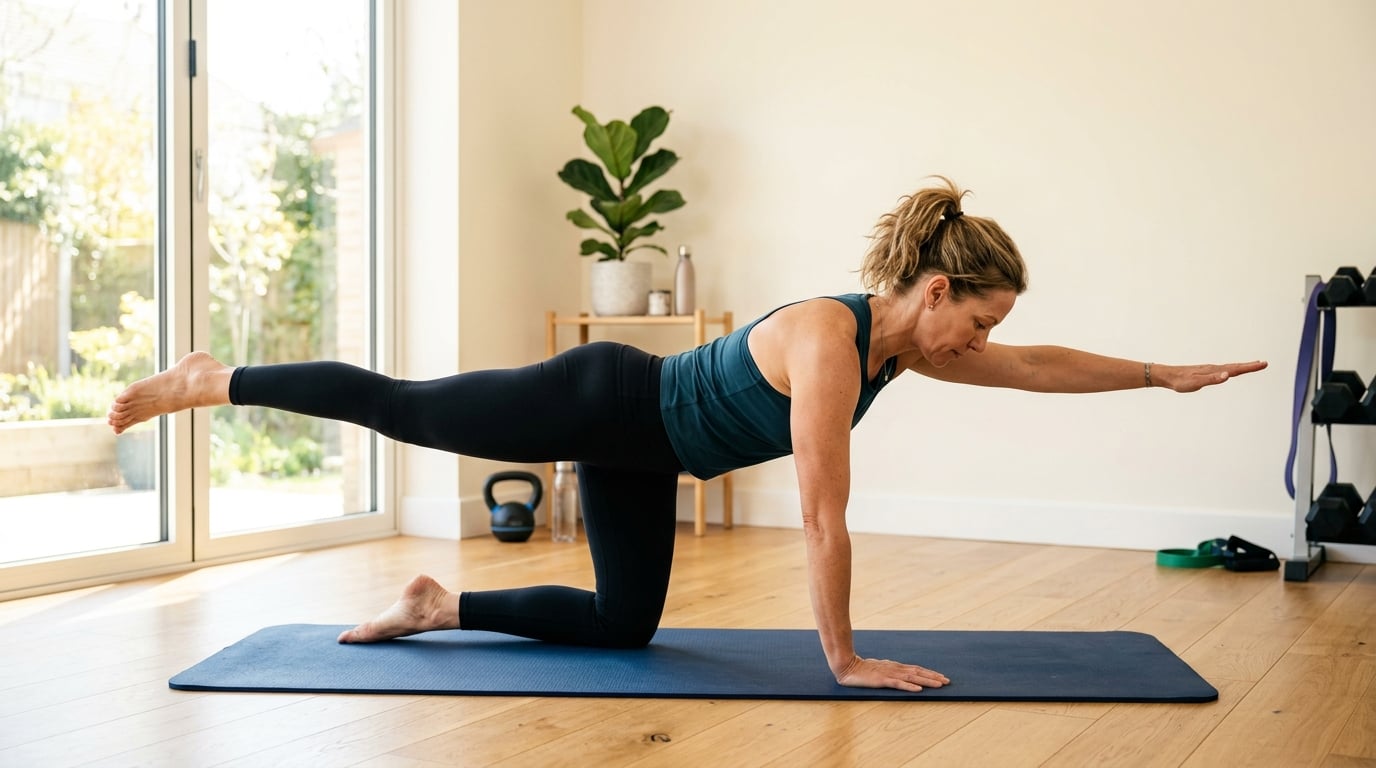
1. The Bird Dog — for core stability
The Bird Dog is part of the famous "McGill Big 3," a set of exercises developed by spine biomechanics researcher Dr. Stuart McGill specifically to build spinal stability without grinding your discs. Unlike sit-ups and crunches — which repeatedly bend your spine — the Bird Dog teaches your core to stay stiff and still while your arms and legs move. That anti-movement stability is exactly what a cranky lower back needs.
Research on stabilization work like this shows improved coordination between the muscles around the spine and reduced pain and disability in people with ongoing nonspecific low back pain.
How to do it: On hands and knees, brace your abs gently as if bracing for a light punch. Reach one arm forward and the opposite leg back until both are in line with your torso. Keep your hips level — don't let them tip. Hold a few seconds, return with control, switch sides. Quality over speed, every rep.
2. The Glute Bridge — for hip and posterior-chain strength
The Glute Bridge directly attacks the weak, sleepy glutes that sitting creates. Strong glutes stabilize your pelvis and take load off your lower back during everything from walking to lifting the groceries.
How to do it: Lie on your back, knees bent, feet flat. Squeeze your glutes and drive your hips up until your body forms a straight line from knees to shoulders. Don't arch your lower back to get higher — the lift comes from your glutes, not your spine. Pause at the top, lower with control.
Do both of these most days of the week. They take five minutes. Consistency beats intensity every single time here.
Don't Forget Your Upper Back and Posture
If your pain lives higher up — between the shoulder blades or in the neck — the driver is usually forward-hunched desk posture. Two more moves that pair perfectly with the two above:
The Reverse Snow Angel strengthens the mid-back muscles that fight the rounded-shoulder slump.
The Doorframe Row trains the pulling muscles that pancake-flat desk work never uses.
Want the full routine? We built a complete, free, no-equipment plan around all of this: the Back Pain After 40 hub walks you through the whole 5-minute daily formula and every exercise in it. You can also browse the entire free exercise library for demonstrations.
Get the weekly playbook. Every week I send one no-BS email with exactly this kind of practical, over-40 training. Join the free newsletter here and I'll help you actually stick with it.
The Bodyweight Factor Nobody Mentions
Extra body weight is a recognized, modifiable risk factor for low back pain — more load on the frame means more load on the spine. This isn't about aesthetics or shame. It's mechanics: dropping even a modest amount of weight can meaningfully reduce the daily strain on your back.
The catch is that eating like you did at 25 stopped working, because your daily calorie burn quietly dropped. If weight is part of your back-pain picture, start by finding your real numbers. Check your maintenance calories to see your true daily target, and run your BMR to understand your baseline. You can't manage what you've never measured.
A 4-Week Starting Plan
Keep it stupid-simple. Complexity is where good intentions go to die.
Weeks 1-2: Bird Dog and Glute Bridge, most days. Add a short walk daily. Set a phone reminder to stand up and move every 30 minutes at your desk — alternating posture through the day beats any single "perfect" position.
Weeks 3-4: Keep the two core moves. Add the Reverse Snow Angel, Cat-Cow for gentle mobility, and a Hip Flexor Stretch to undo the tightness sitting creates. Nudge your daily walk a little longer.
That's it. No gym, no equipment, no gadgets. Just the boring, proven basics done consistently.
When You Should Actually See a Doctor
Most back pain is mechanical and improves with movement. But some symptoms are red flags that mean you need a professional now, not a home routine. See a doctor promptly if your back pain comes with any of these:
This article is general education, not a diagnosis. When in doubt, get checked out — especially with any of the above.
The Bottom Line
Your back didn't betray you, and 40 isn't a cliff. The most common back pain after 40 comes from a body that got weak and sat too much — and both of those are things you can change. Rebuild your core with the Bird Dog, rebuild your hips with the Glute Bridge, keep moving through your day, and give it a few honest weeks.
The fix was never a fragile spine you had to protect. It was a strong one you had to build.
Ready to follow the full routine? Start with the Back Pain After 40 hub, and grab the free weekly newsletter so the next step always lands in your inbox.
Want More Like This Every Week?
Get one move, one insight, and one quick win — delivered weekly and built for adults over 40. Free forever.
Send Me The Formula →No spam. No fluff. Unsubscribe anytime.